The 5 Most Fascinating Bees in the World

Bees are cool and when most people think of bees, they usually imagine either a honeybee or big bumblebee. There are, however, over 20,000 species of bees on Earth! Yeah, that's a lot! This means there are quite a few different types of bees in various ecosystems from rain forests, to open plains, and wildflower prairies. Let's talk about what many people agree are some of the most fascinating bees on Earth..

The Teddy Bear Bee - these bees resemble exactly what you're thinking: a teddy bear. They're big and fuzzy, and .. well, cute. They are part of the Carpenter Bee family and are considered excellent pollinators. This is mostly because they are "solitary" bees and don't live in a hive or colony like honey bees, which produce honey, comb, beeswax, pollen, and royal jelly. They are, of course, only found in Australia, but unlike many other creatures from "down under", they won't murder you and are generally docile and keep to themselves. The males don't even sting. One cool fact is that they use "sonification" to vibrate the flowers at a specific frequency to shake the pollen loose. That covers the little hairs over their bodies and allows pollination for hundreds of different flowers, nuts, fruits, and vegetables.

The Wallace's Giant Bee - This creature, like many other species, is named for the person who discoved it. A British naturalist, Alfred Russel Wallace, bumped into the bee in 1858. Rarely seen, the bee was feared to be extinct for the next hundred years until its brief rediscovery in 1981 by Adam Messer. And then, poof! It vanished again until 2018 when specimens began to appear online. This prompted a search team to locate and actually film a live female in January 2019 on a remote Indonesian island. We're sure she wasn't impressed by all the attention. The female bee is a BIG BEE, about 1.8 inches long (hey, that's big for a bee) and she is much larger than the male bee. Also, she doesn't like to build her own nest. In fact, she steals space from termite colonies to lay eggs and seal off the area with sap she gathers from tree bark. These bees have a giant front-facing "jaws" that resemble the Stag Beetle features. They use this to scrape bark and scare the snot out of potential predators. She is known locally in Indonesia as, raja ofu, which translates directly to "king of the bees" - or, queen in this case.
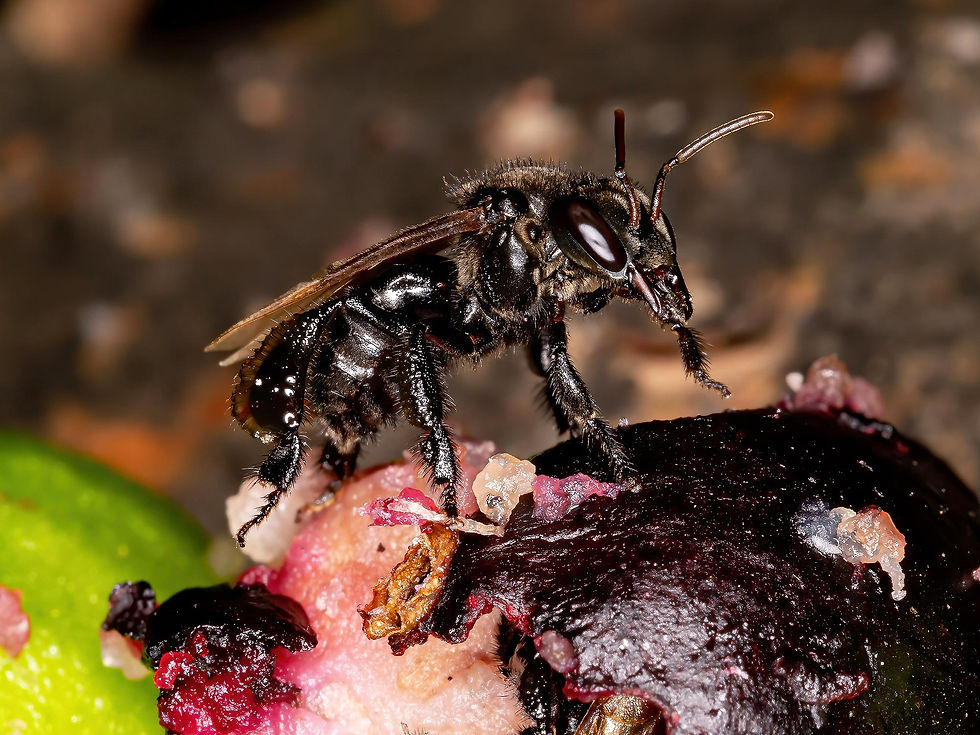
The Vulture Bee - This species is going to sound like a Stephen King creation. It's one of nature's strangest bees. It is one of the only bees that has abandoned pollen as its source of protein and eats... roadkill. Yes, the Vulture Bee eats dead animals like lizards, rodents, and other carcasses. They enter their dead prey only through it's eye sockets. Yeah.
They are found in Central and South America and are (thank God) stingless bees. These bees live in colonies, like honeybees. They regurgitate, both the meat along with nectar, into cells which are then processed by other bees using their own enzymes and a special bacteria to create a unique honey and royal jelly. The interesting part of this is that they process the meat and pollen separately, then blend them together in another part of the hive. We told you this bee was weird.

The Blue Carpenter Bee - Moving away from the Addams Family species of bees, let's meet the beautiful Blue Carpenter Bee. One of the first interesting things about this species is that, unlike other species of animals, the female is the most striking and colorful of the group. These are also solitary and mostly docile bees that are amazing pollinators. They can pollinate flowers about 15x more efficiently than honeybees. They love Eggplant and Tomato plants. They are usually found in South East Asia and India. They typically live inside trees and deadwood where they can burrow, nest, and lay eggs. Females usually live a year or more, unlike most honeybees that only live 45 days on average. Some tracked bees have even lived up to three years.

The Orchid Bee - Another color and impressive bee is this tropical species. These are not social bees in that they are very solitary. They also feature a bright, metallic outer body that makes them look like they should be a Marvel character. (no Bumblebee references please). Some members of this group can be gold, purple, blue, and copper in their appearance. Since the flowers (Orchids) that they pollinate, have deep pockets where nectar is found, their tongues (proboscis) can be twice the length of their bodies.
Males love to collect the unique smell of different flowers and combine it with their own pheromones to use as a "cologne" to attract females. Just like Saturday night at the club. Females judge the complex blending and aroma as a way to select the best mate. These bees are unique in their contribution to pollinating Brazil nuts.
So, celebrate uniqueness! Arkearth is here to save all types of pollinators. These five examples underscore how important conservation and biodiversity are to our planet.
Here's Lesson One: protecting pollinators isn't just about saving honeybees. Healthy ecosystems depend on thousands of highly specialized bee species, each filling a unique ecological role—from pollinating specific crops to sustaining rare flowers and beautiful environments. Check out our store for unique products and solutions you can incorporate into your own backyard, front porch, balcony, or windowsill. We can all do something to save nature, and it's going to take all of us doing it!


Comments